Localising Shopee and Lazada images for Thai, Vietnamese and Indonesian
Run one set of creative through a translator and upload it to six Southeast Asian sites, and problems pile up: broken Thai line breaks, garbled Vietnamese tone marks, text spilling out of boxes. Here are the traps by language and a workflow that avoids them.
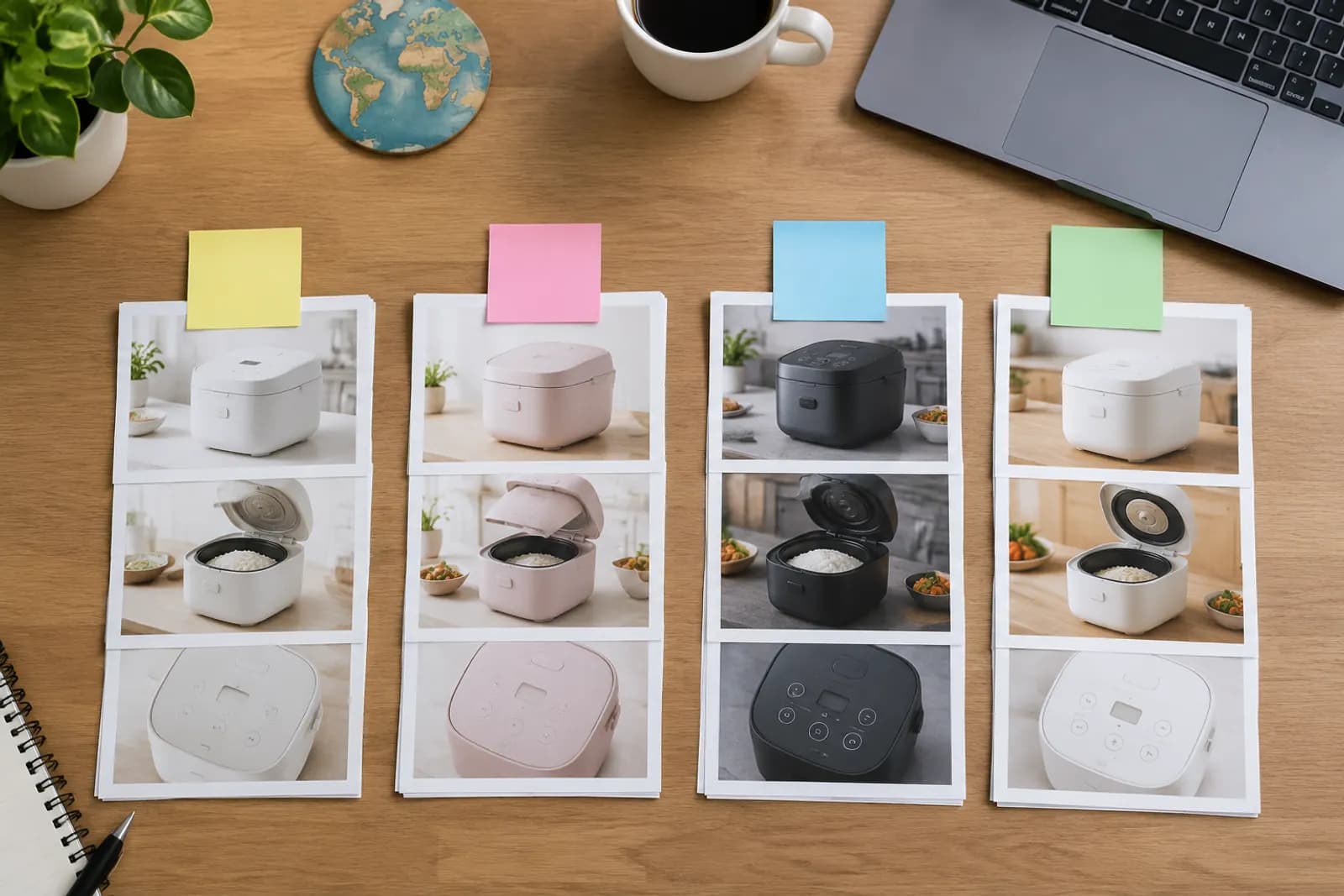
Most sellers in Southeast Asia go through the same phase. Finish a set of creative, run the text through a translation tool, swap in the target language and upload to five or six sites. Everything looks fine until a buyer comments that they can't read the text on the image, or you open the Thai site and find your benefit text broken into strange fragments.
Southeast Asian languages differ more than most people expect, and each one breaks images in its own way.
Sites and languages
| Site | Main language | Text on images |
|---|---|---|
| Thailand | Thai | Mostly Thai, a little English is fine |
| Vietnam | Vietnamese | Vietnamese |
| Indonesia | Indonesian | Indonesian |
| Malaysia | Malay, English; large Chinese-speaking audience | English or Malay; Chinese works in some categories |
| Philippines | English, Filipino | Mostly English |
| Singapore | English, Chinese and others | Mostly English |
English creative usually works in Malaysia, Singapore and the Philippines. Thailand, Vietnam and Indonesia are where the effort goes.
Thai: no spaces, so check line breaks by hand
Written Thai doesn't put spaces between words, only between phrases or sentences. Many design tools can't detect Thai word boundaries, so when a text box is too narrow they break lines mid-word — the equivalent of splitting an English word across two lines.
What to do:
- Keep Thai benefit text short enough to fit on one line;
- Where a break is unavoidable, have a Thai reader confirm where it falls;
- Thai has tone marks and vowels above and below the line, so use more line spacing than for English, or marks collide with the line above;
- Pick a font with full Thai support; missing glyphs show up as boxes.
Vietnamese: diacritics and fonts
Vietnamese uses the Latin alphabet with many diacritics, sometimes two stacked on one letter. Typical problems:
- Font gaps. Many English fonts lack full Vietnamese coverage, so accented letters fall back to another font and look mismatched.
- Displaced marks. Some software mishandles combining characters, shifting or overlapping tone marks.
- Tight line spacing. Marks get clipped or touch the next line.
Zooming in on every accented letter before upload is far more reliable than judging the image as a whole.
Indonesian and Malay: close, but not interchangeable
Indonesian and Malay share roots and many words, but plenty of everyday terms and spellings differ. One translation for both markets reads as slightly off to local buyers. On a tight budget, at least translate titles and the main benefit separately.
Both also tend to run much longer than Chinese, and often longer than English. A six-character Chinese benefit can need three or four words. Design benefit boxes with room to spare.
Text length: plan for the longest language
Overflow is the most common layout failure in multilingual sets. Design source files around the longest version:
- Size text boxes for the longest language and centre shorter ones;
- Set a minimum font size; if text is too long, cut words rather than shrinking type indefinitely;
- Limit each image to one headline and one or two lines of support;
- Keep numbers, units and prices in separate blocks that don't need translating.
Beyond product images: campaign assets
Shopee and Lazada run a dense calendar — 9.9, 10.10, 11.11 and 12.12, plus each country's own holidays. Localise campaign assets ahead of time:
- How each site writes the campaign name;
- Currency symbols and price formats (baht, dong and rupiah differ enormously in digit count);
- Local festivals such as Songkran in Thailand or Eid in Indonesia.
Price formats catch people out. Vietnamese dong and Indonesian rupiah amounts often run to six or seven digits; a price box sized for a short price will overflow.
A multi-site workflow
- Master design in English, with all text on separate layers and a maximum character count noted for each box;
- Translation per site, with a native speaker reviewing titles and core benefits;
- Swap in text on the layers, or process finished images with image translation;
- Manual check per site using the list below;
- Upload per site — when copying listings between sites, don't forget to replace the images.
Pre-listing checklist
- No text overflowing or clipped;
- Thai line breaks correct, tone marks intact;
- Vietnamese accented letters rendering properly;
- Indonesian and Malay handled separately;
- Prices, currency symbols and number formats follow local convention;
- No leftover Chinese or English;
- Text legible on a phone screen.
A small example
A hair dryer listed on five sites originally used one English image set. Thailand and Vietnam converted noticeably worse than the others. The team replaced the main benefit image with Thai and Vietnamese versions and restyled the lifestyle shot with apartment interiors closer to local homes. How much that helps varies by category and timing, but their takeaway was clear: the language on the main benefit image is the first thing worth localising, ahead of scenes.
For localising lifestyle imagery, see TikTok Shop US vs Southeast Asia, which covers shooting once and reusing across markets.
Upload one product photo and get a full set of listing-ready visuals in minutes.
Keep reading
Testing Amazon main images with Manage Your Experiments: design, duration and reading results
Read article
TikTok Shop US vs Southeast Asia: why one product needs two sets of creative
Read article